Barefoot Gen and Two Great Peace Walks, 5 Decades Later
Hiroshima, August 6, 1977. Suddenly, a commotion — punctuated by very loud short bursts of whistles — can be heard emanating from the main street. A long line of riot police wielding huge shields is trying to keep up with a rapidly moving column of young men and women waving antinuclear flags and signs filling a lane of traffic. Near the front is a police van with an observation deck on top holding three cops with walkie talkies and loudspeakers. A similar vehicle brings up the rear.
The demonstrators, sometimes trotting, sometimes walking swiftly, initiate the “snake dance” — lining up single file with hands on the hips of person in front, very tightly packed together, zigzagging down the street; at times making quick, rapid steps, while continuously chanting when not blowing whistles.
The cops are very uptight and obviously fearful the protesters will suddenly dart off into a physical confrontation, which, once the “snake” is initiated, is virtually unstoppable. Completely fascinated, I follow alongside. It eventually ends without incident at the city’s main auditorium, location of the evening’s rally commemorating the 32nd anniversary of the Hiroshima bombing.
[https://www.britishpathe.com/asset/238015/, 2 1/2-min.
Japanese video of 1977 peace walk and world conference]
A few weeks earlier and 250 miles north of Tokyo a distinctly different scene unfolds as two other Americans and I join one of the five (out of 14 total) antinuclear peace walks infused with foreigners. Each day as we head towards Tokyo through a rural area of Miyagi prefecture — mostly populated by rice paddies — we three along with organizers, local residents, and a translator walk through mostly small towns carrying banners and large colorful flowing flags representing various sponsoring constituencies (e.g., labor, youth, women). This time instead of police vehicles, we are accompanied by a truck playing antinuclear music interspersed with peace messages.

On our first day, the walkers (numbering about 50) were startled to see foreigners —Americans, no less — joining them. As we headed into town for a rally, people came up to express appreciation for our being there. Though marches like this are common in big cities, especially this time of year, they’re very rare and quite a curiosity in the countryside.
The rally lasts about a half hour. Speeches were short and always included greetings from one of us aliens, then a singing of an antinuclear song. Sometimes this includes a ceremonial transfer of flags from one prefecture to the next.
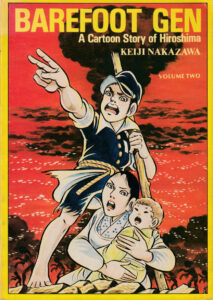
The year before, 1976, Masahiro Oshima, a young pacifist activist from Japan, joins the southern route of The Continental Walk for Disarmament and Social Justice, and strikes up a friendship with longtime WRL staff member Jim Peck. As they walk together Masahiro introduces Jim to the iconic pacifist manga comic Hadashi no Gen (Barefoot Gen) by Keiji Nakazawa, which very graphically tells the story of the Hiroshima bombing from the viewpoint of a 6-year-old survivor. Oshima, longing for an English translation and buoyed by Jim’s enthusiastic support, returns to Japan and visits Nakazawa to get his consent.

Thus began the process that resulted in the publication of the first two volumes of Barefoot Gen in English (280 and 340 pages), distributed in the United States by WRL Coincidentally, this also became the first Japanese comic to be translated into a Western language.
During the 1977 Japanese peace walks, organized by Gensuikyo (a major antinuclear organization), a 32-page prospectus of Barefoot Gen is distributed to English-speaking participants. This was the first year Gensuikyo invited foreigners (predominantly Americans) to join the walks. The 1977 joint world conference with Gensuikyo and Gensuikin (the other major Japanese anti-nuclear group) also represents the beginnings of the reunification of the Japanese antinuclear weapons movement, split since 1963 by political differences over the partial nuclear test ban treaty.
Almost five decades later (in February 2025), a six-person camera crew from the Japan National Broadcasting Corp. (NHK) came to Brooklyn to interview me for a documentary regarding Jim Peck’s “pivotal role” in getting Barefoot Gen translated into English. The documentary, in part, focuses on that “fateful encounter,” featuring Oshima, Peck, The Continental Walk, and WRL.
Since Jim died in 1993, NHK sought a WRL representative who knew Jim, was involved with The Continental Walk, and was familiar with Barefoot Gen. I volunteered. It also helped that I participated in that 1977 Japanese peace walk.
Six months later on July 26, 2025, the 48-minute documentary “Manga that Made It to America — Barefoot Gen” premiered in Japan. Jim (62 in 1976), portrayed as “a sympathetic legendary American elder,” is brought to life through several demonstration photos, recollections of Masahiro Oshima (and, for about a minute, me), as well as a fanciful recreation of Jim and Masahiro on the southern route of The Continental Walk.
Sadly, there isn’t an English language version but I understand it can be viewed in Japanese at www.nhk-ondemand.jp/goods/G2025148387SA000/?spg=P202400389100000 for 220 yen (about $1.50).
Ed Hedemann, longtime antinuclear activist based in Brooklyn, was a member of the WRL staff from 1973 to 1986, national coordinator of The Continental Walk, and is a member of NYC WRL.
Share