Young Indiana Jones and the Rise of Pacifism
Lucasfilm released a series of educational, historical documentaries in 2007. They were companions to “The Adventures of Young Indiana Jones,” a television series created and produced by George Lucas/Lucasfilm in the 1990s. Lucas wanted to inspire interest in history, taking advantage of the popularity of the Indiana Jones feature films starring Harrison Ford. Twenty-two television films explored the childhood through young adulthood of the Indiana Jones character, sending him around the world and placing him in plots with major historical events.
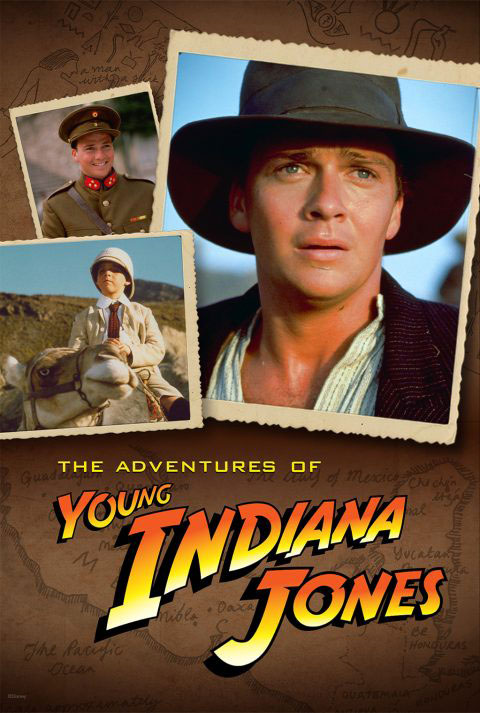
In conjunction with these fictional television films, Lucas went deeper into the events of the films with 94 half-hour documentaries for school use. They cover a diverse range of topics across art, history, science, literature, politics, and philosophy.
About the documentaries Lucas said, “I have always found that it is easier for students to relate to historical figures when they see them as human beings rather than dates and dry descriptions of events. I feel this approach makes history easier to understand and more accessible to students.”
And now, to the War Resisters League. One of the documentaries is called Waging Peace: The Rise of Pacifism. The film highlights the feminists and pre-World War I antiwar and peace activists who were disappointed by their failure to stop the war, but were motivated by the horrors of that war to build a stronger pacifist movement with a vision of ending war itself.
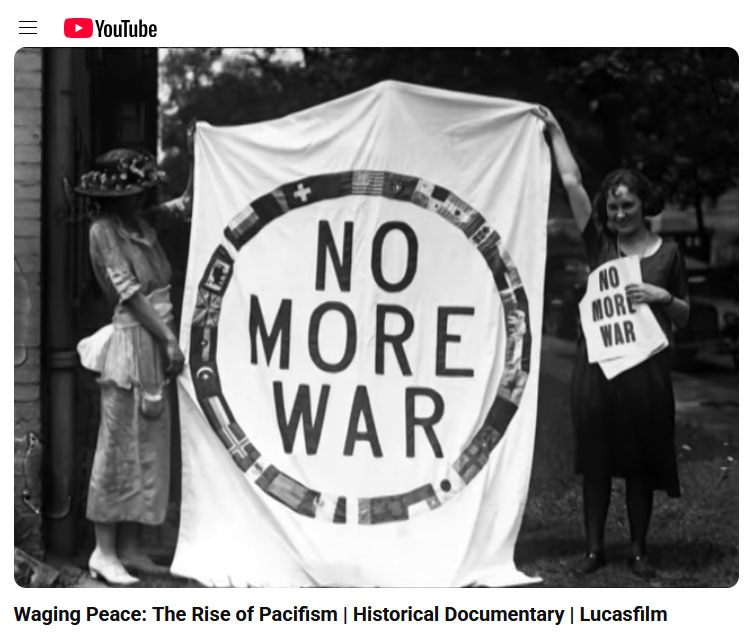
The Fellowship of Reconciliation (FOR), founded in 1914, was one of the early religious pacifist groups opposing WW I. Richard Deats, a former staff member of the FOR, is interviewed in the documentary. Midway into the half-hour film author Frances Early (A World Without War: How U.S. Feminists and Pacifists Resisted World War I) introduces “brilliant socialist theorist” Jessie Wallace Hughan, who was a member of FOR at the time. Early says, “Hughan decided that the Christians in the Fellowship of Reconciliation would never be able to end war on their own. So, she started a new group that would welcome non-Christian and non-religious opponents of war into its ranks too. She called it the War Resisters League.”
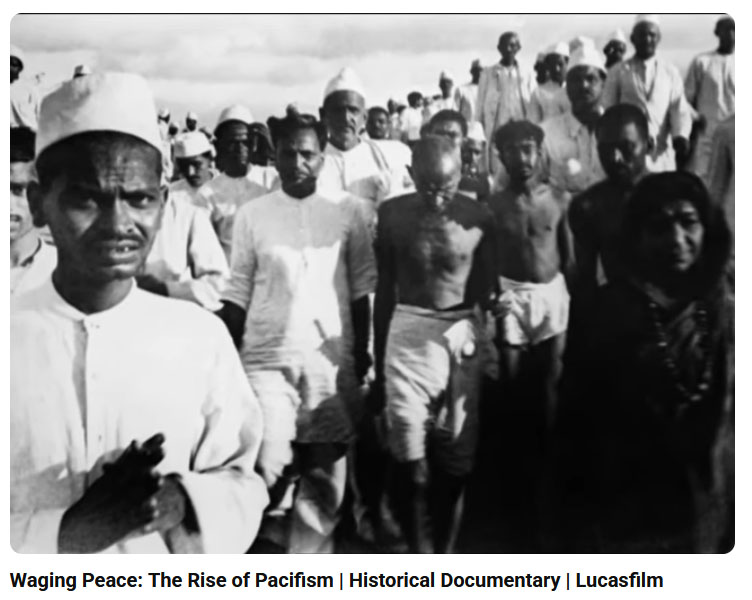
Arun Gandhi, grandson of Mohandas Gandhi, speaks about Gandhian philosophy, the Salt March, and direct action. WRL activist and former staff member Ed Hedemann is also interviewed. As to Gandhi he says: “The feeling from Jessie’s point of view, as well as a lot of others, is sort of the Gandhian philosophy that the ends and means are the same. If you use wars to end wars, you’re going to use wars and you’ll get wars. If we want to get a world without wars, violence and injustice, then we should not use wars, violence and injustice to achieve it.”
During the WRL centennial celebrations of 2023 we had forgotten about this little gem of a film. Reminded of it recently, we bring it to light and encourage you to give it a look and share this film and the whole series with teachers you know.
Note: Many of the photos in the film are from the Swarthmore College Peace Collection.
Ruth Benn is active with NYC WRL and a member of the WRL Centennial History Committee.
Share