WRL Exhibit on Hiroshima, Nagasaki and Nuclear Terror
In 1995 on the 50th anniversary of the atomic bombings of Hiroshima and Nagasaki, the Smithsonian Air & Space Museum unveiled a radically scaled back exhibition that glorified the bombings, prominently presenting Enola Gay (the Hiroshima bomber) as if it were a holy relic.
The original draft text of the exhibit had been an even-handed history and evaluation of the August 6 and 9, 1945 bombings. But caving to howls of the American Legion and conservative members of Congress, the Smithsonian deleted all criticisms of the bombings and presented a sanitized version without graphic images of the destruction. Instead, they highlighted how the plane was restored, showed photos of machinery, interviews of the Enola Gay crew, and stressed how “the bombings were necessary” to save American lives.
Consequently, WRL with other peace groups formed the Enola Gay Action Coalition to prepare for protests at the opening, as well as to create our own exhibit “Hiroshima, Nagasaki, and 50 Years of Nuclear Terror”—as an answer to the Smithsonian’s crude attempt at censorship and historical revisionism.
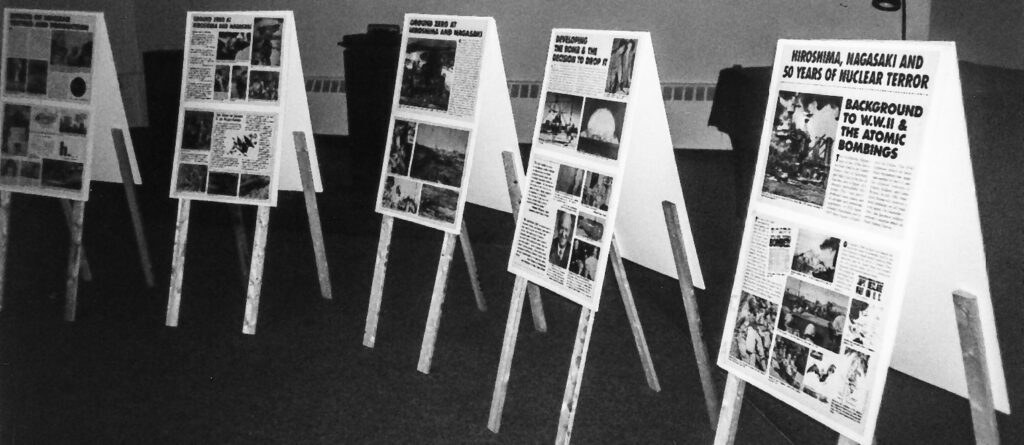
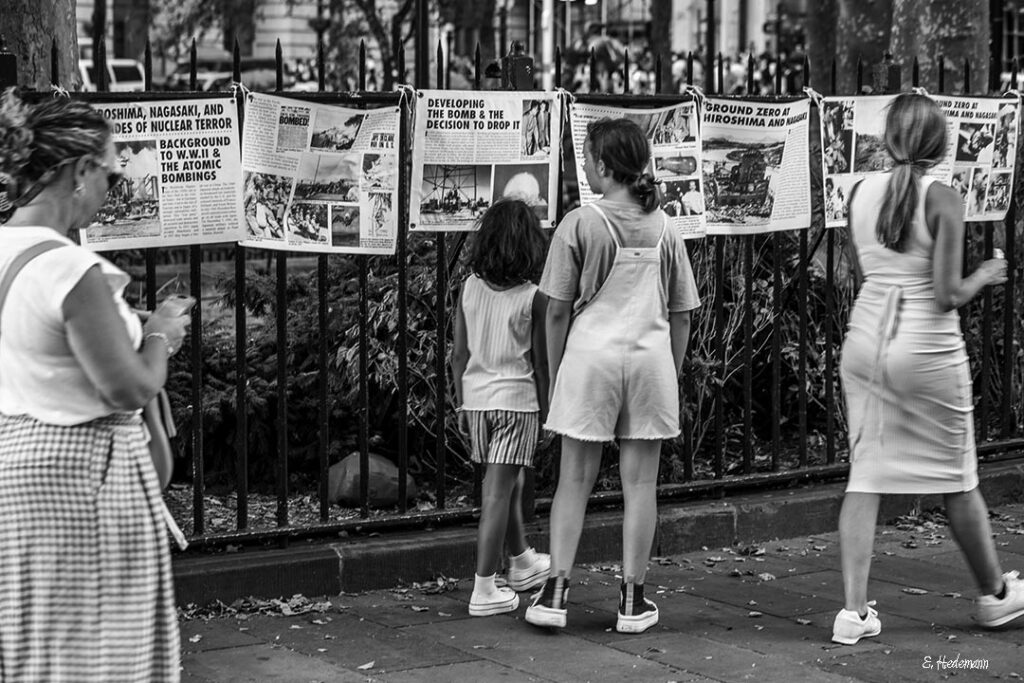
In 1995 this people’s exhibit, consisting of 20 image-intensive panels, was duplicated as a package and sent to over 100 communities in 31 states and five foreign countries. Though the most popular places for display were churches, libraries, and parks, the Exhibit was also shown in hospitals, civic and community centers, union halls, convention centers, peace offices, schools, colleges, universities, retreat centers, at least one state capital (Austin, TX), and outside the Smithsonian’s Air and Space Museum.
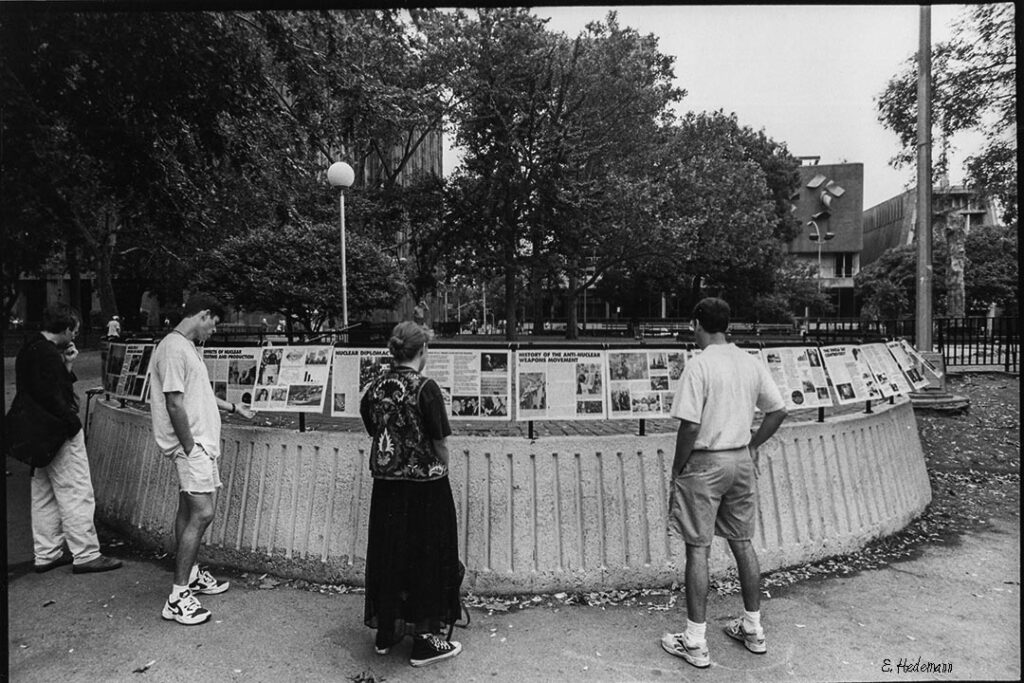
In a display of local creativity, the Exhibits—whether laminated, mounted, or shown au naturel—were put up on walls, tacked to bulletin boards, propped up on easels, attached to columns, strung along clotheslines, hooked on park railings, leaned up against walkways, spread out on tables, and held like placards on peace walks.
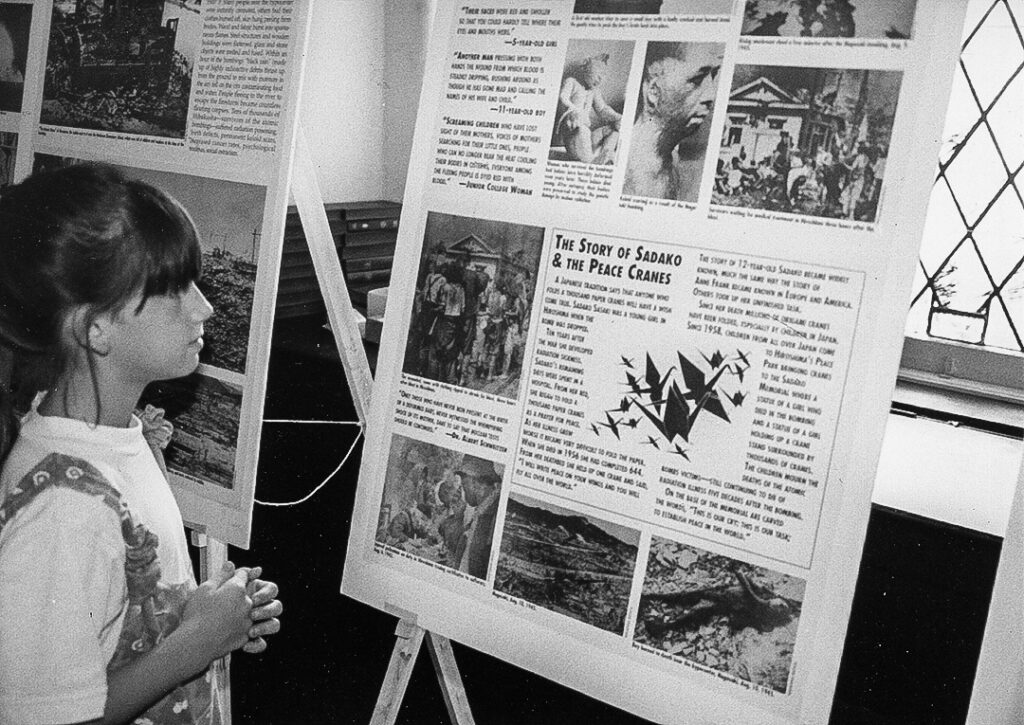
The Exhibit was the main event in many communities, but frequently it was complementary to memorial services and commemorations as well as lectures, forums, video and film showings (Asheville, NC and South Bend, IN), concerts or sing-alongs (Poughkeepsie, NY, Louisville, KY, Colorado Springs, CO, Ukiah, CA, Houston, TX), tree plantings (Palo Alto, CA), lantern floatings (Richmond, VA, Spokane, WA, Louisville, KY, Seattle, WA, South Bend, IN), paper crane foldings (Houston, TX, Somerville, MA, Colorado Springs, CO, Baltimore, MD).
In some communities it provoked vigorous debates and, despite their best efforts, activists discovered that the Smithsonian wasn’t the only public institution interested in covering up the United States’s complicity in nuclear terrorism. Public officials and conservative librarians in New Haven, CT, Austin, TX, Tucson, AZ, Albany, OR, Ukiah, CA, Spokane, WA, among other locations tried—in some cases, successfully—to prevent the showing of the Exhibit.
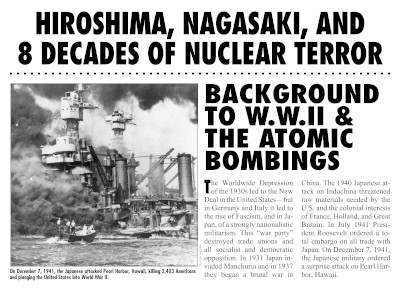
Over the years there have been revisions in a few of the panels to reflect the passage of time (e.g., now “8 Decades” instead of “50 Years”), addition of new antinuclear groups, latest count of nuclear weapons, new developments in nuclear technology, more recent examples of nuclear saber-rattling, and so forth. Since the first showing in 1995, the NYC WRL has displayed the exhibit annually in NYC public parks every Hiroshima-Nagasaki weekend.
The full exhibit can be found on WRL’s website or at Slide Share, where you can view or download the panels. Click here to watch a brief Associated Press video of the 1995 opening day demonstration at the Smithsonian.
– Ed Hedemann, who refused induction into the U.S. Army on 24th anniversary of Hiroshima bombing, August 6, 1969, was a former member of WRL staff and an organizer with Enola Gay Action Coalition.
Share