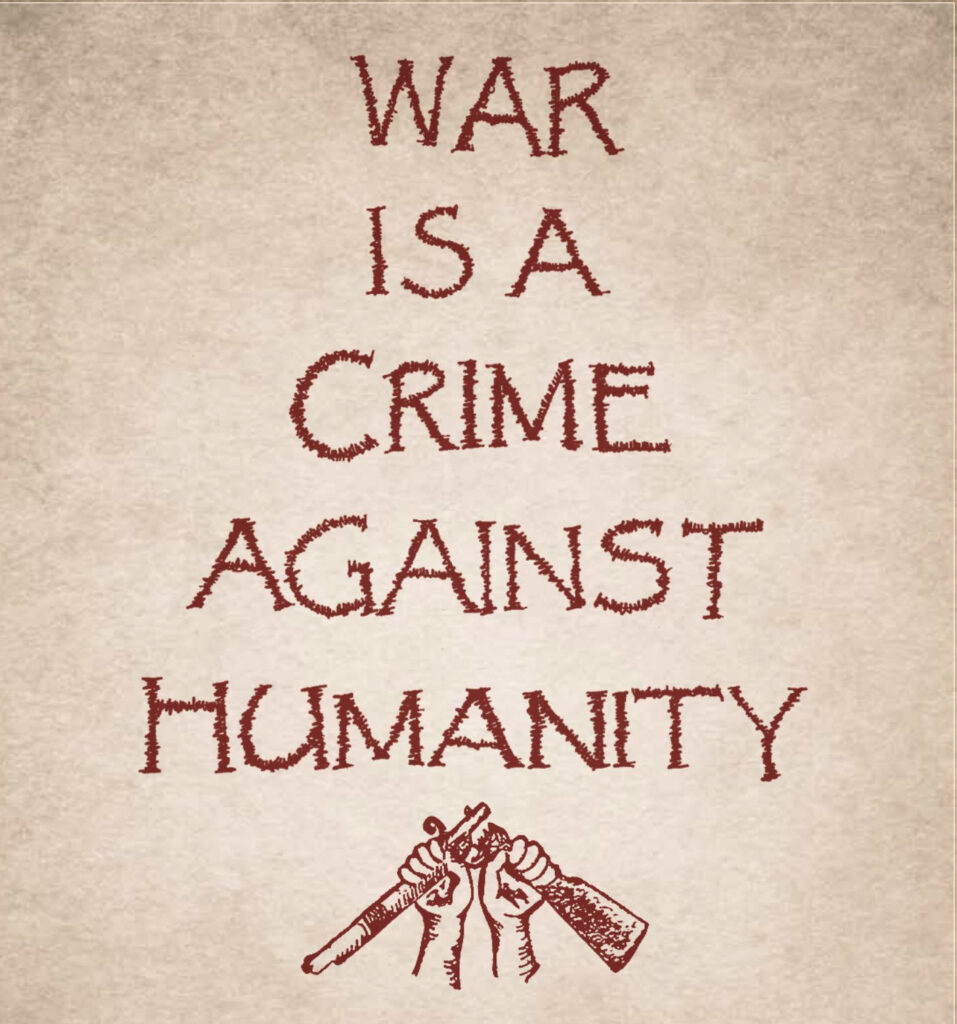
The War Resisters League affirms that all war is a crime against humanity.  We are determined not to support any kind of war, international or civil, and to strive nonviolently for the removal of all causes of war, including racism, sexism and all forms of exploitation.
Statements and Analysis on Ukraine, January 2022

War Is A Crime Against Humanity (lettering by Liz McAlister)

War Resisters League believes that war is a crime against humanity; we are clear that war is never the answer. As an antimilitarist organization we refuse to take sides between the armed camps. We do recognize and oppose what the U.S. does and is doing to feed this conflict, and other conflicts. We stand with others in War Resisters' International in opposition to war over Ukraine, and support those who refuse to fight.

Escalating tensions between the world's two largest nuclear powers once again points out the pressing need for disarmament, and the dismantling of NATO and other military alliances. Instead of  the U.S. building new nuclear weapons, we urge it and others to ratify and implement the Treaty on the Prohibition of Nuclear weapons now signed by 86 countries.

War Resisters League knows that the conflict over Ukraine benefits the weapons suppliers, expanding militaries, and a handful of political elites. Ukranians, caught in the middle, will be first ones to suffer.

We share these statements from others involved in War Resisters' International.

She Wove Us Together: Linda Marie Thurston, 1958-2021

Linda with raised fist

Linda Marie Thurston, who spent a lifetime forging connections between and among people, organizations, and ideas in peace and justice movements, passed away in her Brooklyn, NY home due to natural causes. She was 62 years young.

Linda was born in Providence, Rhode Island, on August 7, 1958, the oldest child of James Thurston Sr. and Barbara Thurston (née Oliver). She attended Classical High School and excelled academically, where, as she liked to tell it, a bet between guidance counselors led to Linda applying and being accepted to Harvard University. Linda graduated from Harvard in 1980 with a B.A. in Cultural Anthropology where she was a student organizer against South African apartheid and was the president of the Black Community and Student Theater. After working for some years at the American Friends Service Committee, Linda took time out to attend grad school at Temple University where she obtained an M.A. in Sociology in 1994. 

Linda was a visionary, intellectual, activist, and social weaver who committed her life towards ending the violence of policing, imprisonment, and militarism, and building systems that promote community restoration, reconciliation, accessibility, and invest in life-affirming resources. Her contributions to the movement to abolish the prison industrial complex are vast and significant. As Director of the American Friends Service Committee’s National Criminal Justice Program, Linda worked with advocates and former prisoners on developing curriculum and organizing conferences, community forums, and workshops promoting prisoner rights and alternatives to imprisonment. Serving in this capacity, Linda edited the 1993 book A Call to Action, by the National Commission on Crime and Justice. As Director of Amnesty International’s Program to Abolish the Death Penalty, she coordinated their strategy to abolish the death penalty, and toured the U.S. to build their campaign. In addition to this advocacy, Linda steadfastly supported campaigns to acknowledge and free U.S.-held political prisoners, including her involvement in co-founding the International Concerned Family and Friends of Mumia Abu-Jamal in 1992. Linda also participated in the founding of Critical Resistance, a national organization working to abolish the prison industrial complex, supporting their work nationally and in New York City in the late 90’s and 2000s and, most recently, serving on their Community Advisory Board.  

One of Linda’s skills was effortlessly communicating her capacious vision across a wide variety of audiences: as a radio host at W.I.L.D, giving testimony on C-SPAN, and meeting with religious congregations, to name a few. But even deeper than public speaking, Linda communicated her abolitionist vision through the way she treated others, every single day. She held firmly to the understanding that people were “not all good, and not all bad,” and was able to hold the complexity of what it meant to be human without romanticization nor disposability. And it’s this energy that brought people together around her, and sustained relationships for decades, and in some cases helped cross-pollinate political ideas, such as the necessity to be both abolitionist and antimilitarist. As her cousin, Kristine Keeling, said, "Linda was committed, she was committed to her community, to the disenfranchised, the displaced, and those who struggled to be heard. She moved with grace, integrity and joy, regardless of the heavy mantle she carried."