WRL News and The Nonviolent Activist Online: Personal Reflection
As the Fall 2022 Freeman Intern, I spent the past several months working with The Nonviolent Activist and WRL News. I found the experience challenging and inspiring. It gave me the chance to reflect on 61 years of resistance and consider my own relationship with pacifism.
The Nonviolent Activist was launched in 1984. I was in second grade. As I read the articles about war toys in The Nonviolent Activist (NVA), I saw my childhood from a different perspective. I loved the women warriors in Star Wars, G.I. Joe, and He-Man, yet my mom refused to buy me the toys. I’m now convinced the antiwar toys campaign inspired her to protect me from the harm caused by the intersection of consumerism and militarism.
In the 1990s, I was a teenager in San Diego county. My family and my community placed a high value on participation in armed services. The Persian Gulf War seemed to me to be focused on yellow ribbons and thanking the troops. When I scanned the coverage in NVA as an adult, that youthful point of view seemed simplistic and reductive.
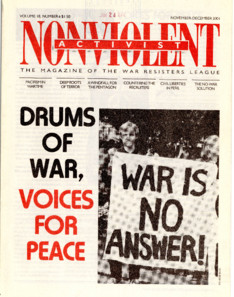 In 1999, I moved to New York. I was 24 on September 11, 2001. I remember how helpless I often felt afterwards, yet I also remember people mobilizing immdiately and the protests in Union Square trying to prevent the years of war ahead. Why didn’t I participate more at the time? These events shaped my life and revisiting them in the pages of The Nonviolent Activist provided me with the scope outside my personal experience that it can be difficult to remember in day-to-day life.
Because my project work started with The Nonviolent Activist and concluded with WRL News, I found myself traveling backwards and beyond my lifetime. Scanning the pages and going through the indexes of The Nonviolent Activist had felt both personal and urgent. I was surprised to find that the stories in WRL News felt the same.
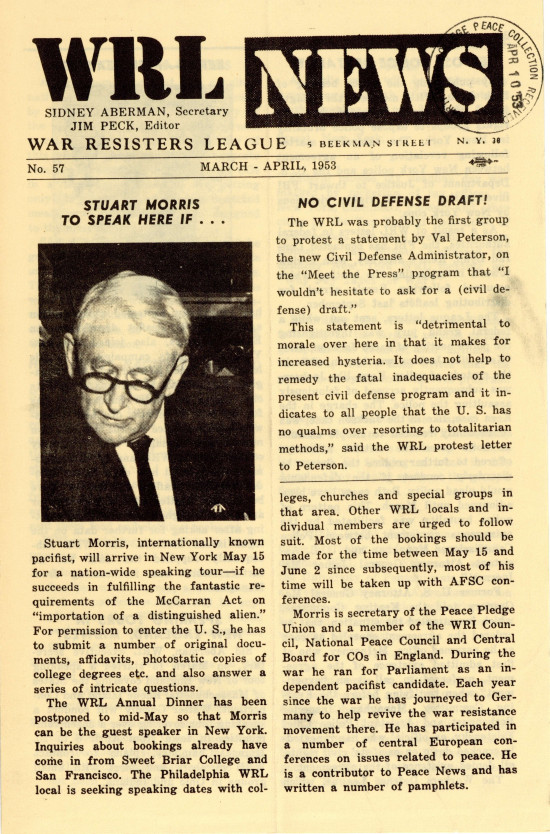 This period covers the movements against nuclear proliferations, the Korean War and the Vietname War, and it tells the stories of the individuals who fought for peace. The first isue of WRL News to include photography shared with readers the face of David Kern, who had been beaten in police custody after an Easter protest. Bayard Rustin shared his personal account of the riot in Harlem in 1964. Nearly every issue has a story of someone who was imprisoned for peace. The digital collection includes the names of over 800 people who are a part of the history of peace. Time and again, I found myself considering the organizers and politicians, writers and artists, victims and survivors who make up the history of the War Resisters League. Each story is an inspiration to resist all forms of violence and an invitation to consider how to participate in nonviolence.
The War Resisters League Publications Digital Collection at the Swarthmore College Peace Collection is now live. It includes WRL News 1945-1966 and The Nonviolent Activist 1984-2006, which are available online for the first time.
– blog post by Laura Melbourne
Share