Texas Peacework and WRL (Part I)
I first heard of War Resisters League some time in the mid to late 1980’s as I was getting involved in protesting the Pantex nuclear warhead assembly plant, from whence comes EVERY finished U.S. warhead, located northeast of where I lived: Amarillo, TX.
I finished my Army enlistment in 1981 with a misty notion to do something about world problems,and little knowledge of HOW, not even knowing the word “activist” I don’t think. I had joined up to get the money to finish college, which I did, graduating from West TX State U. in Canyon a few miles south of Amarillo in Aug 1984 with a degree in Animal Science and acceptance to veterinary school at Texas A&M. As I was preparing for the long trip southeast across Texas, these people were holding this amazing peace gathering, camping in the bar ditch* beside the Pantex plant gate NE of Amarillo. I was intrigued, but also busy packing to move to College Station, so I didn’t attend.
I ended up not staying in vet school for many reasons, but one reason was thinking maybe I had found the activism that I came out of the Army kinda interested in, and sure enough I had found it. I slowly got pulled into the Red River Peace Network, which became a WRL affiliate.
The Red River Peace Network, nuclear resisters from TX and OK (the Red River is the border between the states) eventually formalized after TX activists got inspired to take action at local outlets of the U.S. military complex by Daniel Berrigan at an FOR retreat in Ft Worth, TX, in 1983. Two WRL affiliates, Houston Nonviolent Action with Bob Henschen representing, and the Dallas Peace Center, Mavis Belisle‘s activist home, and others from the area got together to create an event.
They organized a Pilgrimage and Peace Camp for late July and August 1984, to wind up at Pantex over Hiroshima/Nagasaki weekend, but beginning with a bicycle pilgrimage across TX, over 600 miles from Houston to Amarillo in the hot summer! They stayed in church halls and school gyms and gave talks against nuclear weapons along the way. Then at Pantex they camped in the ditch, did nonviolence trainings, and learned about nuclear weapons.
After that first peace camp Red River Peace Network (RRPN) formalized and itself affiliated with WRL. In 1985, the 40th year since the bombings of Japan, I attended the big 10-day long, 1000 attendee peace camp, with big speakers like Dan Ellsberg and Ed Asner. I was a bit of a sensation at the camp, as few Amarilloans would drive 18 miles NE to mingle with crazy peaceniks from out of town and out of state!
In hopes of establishing a permanent presence near Pantex, a couple from RRPN moved to Amarillo and began holding monthly meetings at the public library. I attended and over the next few years got more involved, and was invited to attend RRPN meetings with the regional organizers, held bi-monthly at a student center of a central TX college.
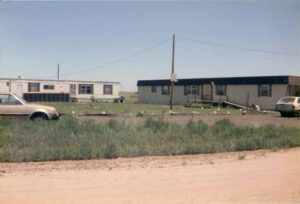
In 1986 the RRPN couple found and, with support from RRPN and local antinuclear Catholic Bishop Leroy Matthiesen, obtained 20 acres right across the highway from the Pantex SW corner, moved a house trailer onto the property, and set up housekeeping as The Peace Farm, watching that trouble-some neighbor, and moving the peace camps out of the ditch and onto the land. At some point I started volunteering at The Peace Farm, joined weekly vigils at Pantex, and moved to “The Farm” in summer 1988.
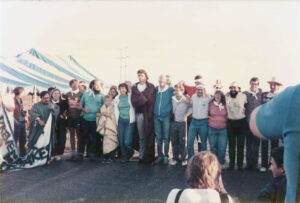
Beginning in 1986 the Pantex Peace Camps often included civil resistance actions blocking the Pantex gates and I learned about risking arrest for a principle. I had my very first 2 civil resistance arrests at the Nevada Nuclear Test Site in late March of 1988 with the affinity group the TX Disarmadillos, many RRPN members. After years of huge protests at the Test Site, arrest had become choreographed line-crossing with no trial or punishment. But I had my first REAL arrest with the farm couple, Cindy and Les Breeding, at the Pantex gate on April Fool’s Day just a few days later. We spent 4 days in jail waiting for our friends to collect unexpectedly high bail. and later at trial were assessed high fines which we couldn’t refuse as they just kept the bail money.
*GLOSSARY: bar ditch – a high plains localism, a wide fairly steep-sided ditch along roads, created by excavating the edges of the proposed road and “borrowing” that dirt to build up the road surface, also the steep ditches are thought to help “bar” livestock from getting into the road
-blog post by Ellen Barfield
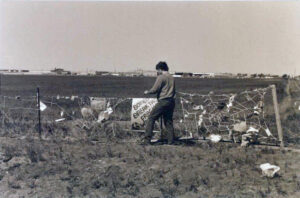
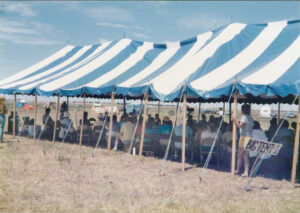
Pictures: (Top) The signs, spider webs, and banners we mounted on the Pantex fence during a Mother’s Day Peace Camp – Photo by Nathaniel Batchelder (Batch) from the OKC Benedictine Peace Hous; (Middle) The “Big Tent” as the sign says, where Peace Camp talks were held; (Middle) House trailer living quarters of the Peace Farm; (Bottom) Blockading the road to the Pantex gate during an August Peace Camp – some stayed to be arrested. Bob Henschen is in aqua jacket, just right of the tallest person in the line who has a brown blanket around his shoulders, and Mavis Belisle in pink t-shirt fourth from right end. Cartoon and photos courtesy Ellen Barfield
Blog post continues in Part II…
Share