WRL Stands in Solidarity with Indigenous-led Movements
On Indigenous Peoples Day and every day, WRL stands in solidarity with Indigenous-led movements and organizations working to build Indigenous power and liberation. For decades, the War Resisters League has supported and worked alongside Indigenous-led movements to protect communities and sacred lands in the southwest from uranium mining. In recent years, WRL has supported Indigenous-led LANDBACK efforts. WRL has also used its publications to share information about issues facing Indigenous people.
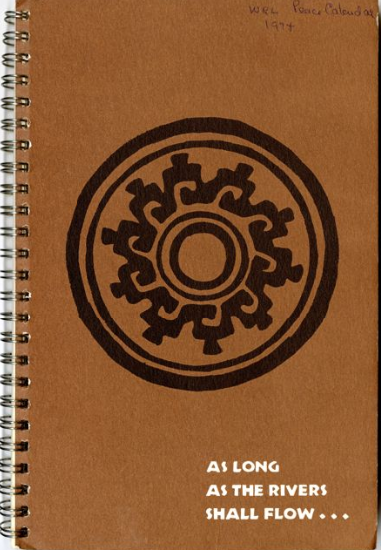
WRL’s 1974 Peace Calendar “As Long As The Rivers Flow…” edited by Wendy Schwartz and Delores McAuliffe featured writing and artwork focused on “the lives, visions and anguish of the American Indian.”
In the late 1970s, Craig Simpson, active with WRL in Albuquerque, wrote articles for WIN about collaborative efforts between anti-nuclear groups and Indigenous groups in opposition to uranium mining. “Native People Oppose Uranium Mining in New Mexico” in the July 20, 1978 issue included statements by Craig, Winona LaDuke, and John Redhouse.
The June 14, 1979 issue of WIN included “Protesting Uranium Mining on Native Land” by Craig with photos by Deb Preusch. Craig’s article and Preusch’s photos chronicled a four-day action at the Mount Taylor where
“… hundreds of Indians, Chicanos and other anti-nuclear activists gathered on Forest Service land to condemn the mining and milling on the so-called Grants Mineral belt, the largest concentration of uranium in the United States. It was an historic moment. It was the first time indigenous peoples had called a national action against uranium mining on Indian land and it was also the largest demonstration by anti-nuclear forces against the front end of the nuclear fuel process. Most of the speakers were Natives, representing the variety of tribes—Navajo, Pueblo, Ute, Hopi— that were present…. The Mount Taylor action was a four day event which brought together spiritual and traditional Indian people, southwest Chicanos (many of whom were involved in land grant struggles) and anti-nuclear people from as far away as Australia, Germany and France. It included New Mexican groups such as Sandoval Environmental Action Community (SEAC), Citizens Against NucIear Threat (CANT), and Albuquerque Citizens Together (ACT).”
In a 2023 WRL history blog article about actions in the 1970s, “War Resisters League – Southwest Campaigns: Kirtland AFB, Sandia and Los Alamos Laboratories”, Craig wrote:

“In the late 1970s the War Resisters League group with the help of members of the Albuquerque Friends Meeting formed the New Mexico Peace Conversion Project, which produced a map of New Mexico’s military and nuclear sites throughout the State. It was an amazing map that included uranium mines, waste disposal sites, and testing sites for nuclear weapons. It aided the work of the Mount Taylor Alliance of Indigenous, Chicano and environmental activists working to oppose uranium mining on the Navajo Reservation and the Waste Isolation Pilot Plant (WIPP) in Carlsbad, New Mexico, which, was chosen in 1973 for a radioactive waste storage site. WRL played a key role in training for a major civil disobedience action at the site. Twenty-six people were arrested, spending 8 to 10 days in jail.”
Opposition to placing a radioactive waste storage site in New Mexico has continued ever since. The good news is that in October 2025, Holtec International officially abandoned its plan to build a massive nuclear waste storage site in southeastern New Mexico — a huge win for the people, environmental advocates, and Indigenous leaders who have fought for years to stop their state from becoming the nation’s radioactive dumping ground.
Continuing efforts to address the long-term health impact of the nuclear industry in Indigenous communities was the focus of a Spring 2009 WIN article “Invisible Legacy: Western Shoshone & the Nuclear Era” by Dr. Bonnie Eberhardt Bobb.

Los Alamos Nuclear Laboratory by Gloria Williams
In 2010, WRL national organizer Kimber Heinz and other WRL organizers joined in actions at the Disarmament Summer encampment in Chimayo, NM, organized by the youth-led antinuclear network Think Outside the Bomb, along with TEWA Women United, the Indigenous Uranium Forum, and the Multicultural Alliance for Safe Environments. Kimber wrote about those actions in “Disarmament Summer Action at Los Alamos” in the Fall 2010 issue of WIN.
That summer, Kimber also traveled to the Grants area of New Mexico known as Mt. Taylor to speak with members of the Multicultural Alliance for a Safe Environment (MASE). In her Spring 2013 WIN article “Uranium Leaves Legacy of Illness in New Mexico,” Heinz says “MASE is a multicultural coalition of local indigenous and non-indigenous grassroots groups based in the Grants Mineral Belt of northwestern New Mexico. The coalition works together to clean up areas contaminated by past uranium mining. MASE is working to prevent future contamination from new uranium activities, to protect the sacred sites of local indigenous peoples, and their community rights to clean drinking water and a healthy environment.” Heinz’s article chronicles the history of militarization of Indigenous lands in New Mexico and the devastating impact of uranium mining there.
On Indigenous Peoples Day in 2020, WRL used our website to amplify the work of the NDN Collective, including its LANDBACK campaign. NDN Collective is an Indigenous-led organization dedicated to building Indigenous power. Through organizing, activism, philanthropy, grantmaking, capacity-building and narrative change, NDN Collective is creating sustainable solutions on Indigenous terms.
Share