Mandy Carter: Scientist of Activism Exhibit and WRL Southeast
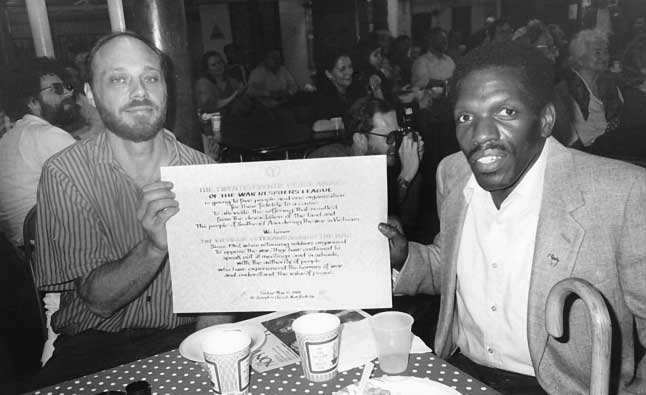
In the spring of 2022, I set out to learn about the work of the War Resisters League Southeast regional office, based in the Triangle region of North Carolina. One person at the heart of that work, and at the heart of many liberation struggles out of the US South during the 1980s and beyond, was long-time antimilitarist activist and Black lesbian feminist Mandy Carter. When I shared the beginnings of my research with staff at the David M. Rubenstein Library at Duke University, they lit up with excitement about the idea of honoring Mandy Carter’s lifetime of activism. Mandy’s papers are part of the Sallie Bingham Center for Women’s History and Culture at Rubenstein Library. I am grateful to have played a small part in the development of an exhibition, launched in the fall of 2023 and curated by Duke History Ph.D. student Kamau Pope, that lifted up Mandy’s life and legacy: Mandy Carter: Scientist of Activism.
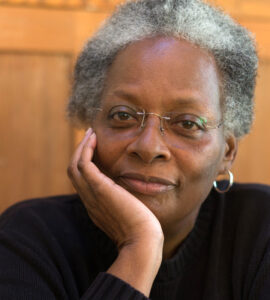
Getting to see Mandy in action is a pleasure; her consistent dedication to showing up—driving for hours or days if she has to—and welcoming people wholeheartedly into a collective process is among her many gifts as an organizer. While staff organizer for WRL Southeast, Mandy was the lead coordinator of the North Carolina contingent of the March on Washington for Lesbian and Gay Rights in 1987, working alongside other WRL members to train participants in a direct action at the Supreme Court challenging the anti-gay Bowers v. Hardwick decision. Participants in WRL Southeast remember it as an antimilitarist hub in the North Carolina Piedmont led by a group of radical lesbian feminists, and Mandy was the fulcrum of WRL Southeast’s work for several years.
Throughout her lifetime as an organizer and movement strategist, Mandy has always connected the dots between issues and struggles, from LGBTIQ liberation to the Black freedom movement to ending war and militarism. In addition to her work with WRL, Scientist of Activism spotlights the organizations that Mandy co-founded after leaving WRL staff, including Southerners on New Ground (SONG) and the National Black Justice Coalition.
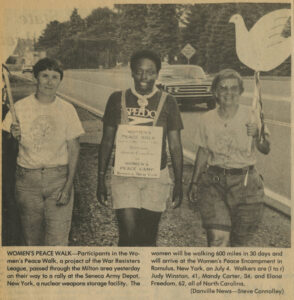
Newspaper Clipping of Women’s Peace Walk, Danville, VA: June 28, 1983
There was little doubt for Mandy that she would continue her nonviolent activism in the post-Vietnam War years; she dedicated her life to forging connections across issues and illuminating new paths towards a more just world. In an interview I did with her and long-time WRL strategist and organizer Joanne Sheehan in 2013, Mandy lifted up WRL as an organization that shared her approach and commitment to movement building:
“Here’s the other question people ask: “Why are you still here doing this?” The longevity factor to me is remarkable. After the Viet Nam War was over, a lot of people said, “I can get back to my life now,” but a lot of other people said, “No, this is just part of this broader issue of equality and justice,” getting into feminism and nonviolence, issues of nuclear disarmament, and so forth. To me that’s what’s intriguing about WRL—its longevity. WRL is in it for the long haul.”
WRL joins the chorus of voices celebrating Mandy Carter.
–Kimber Heinz (Curator of WRL Southeast exhibit)

Share