WALKING, WALKING, WALKING: Reminiscences of The Continental Walk 50 Years Later
“[We were on] the Walk from San Francisco to Riverside and it changed our lives. We were all students from Friends World College, and were all looking for student projects when we came across an ad for The Walk. . . . All I can say at this point almost 40 years later is WOW! It shook out our minds in so many unforeseen ways. We met so many people that we would have never met under any other circumstances. We saw so many things that we would have never seen.”
—excerpt from a 2013 Amazon book review
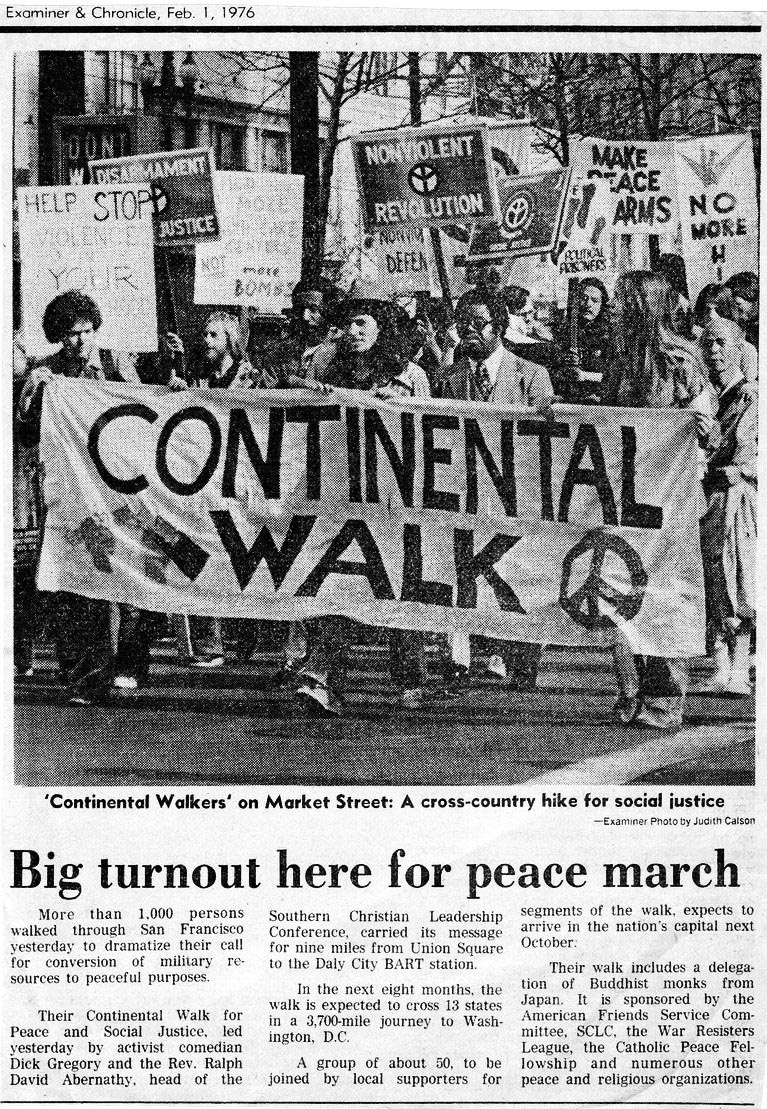
It was the year of the Bicentennial, Gerald Ford was President, and — with the just-ended U.S. war in Vietnam — nuclear issues were once again beginning to dominate the peace movement’s agenda.
Walkers, organizers, movement heavies were three roles that embodied The Continental Walk for Disarmament and Social Justice. Obviously, without walkers — whether for an hour or all nine months — there would be no Walk. However, the vast majority of the participants — an estimated 20,000 — were day trippers, short distance walkers from all over the United States, as well as participants in the SF Bay Area events at the start and Washington DC events at the end.
NEW ORLEANS
National organizers were encouraged to spend time on a Walk route, so 11 days in May in northern New Mexico was my opportunity. However, the month before that I took a whirlwind trip of just two days to fly to New Orleans for the start of the southern route of the Walk, which was being coordinated by the Southern Christian Leadership Conference.
I arrived at Dillard University on April 4th for events commemorating the ninth anniversary of Martin Luther King’s assassination. Overnight I roomed with one of the Japanese monks (Rev. Sera) who insisted on giving my shoulders a shiatzu massage. Perhaps he thought I was tense?
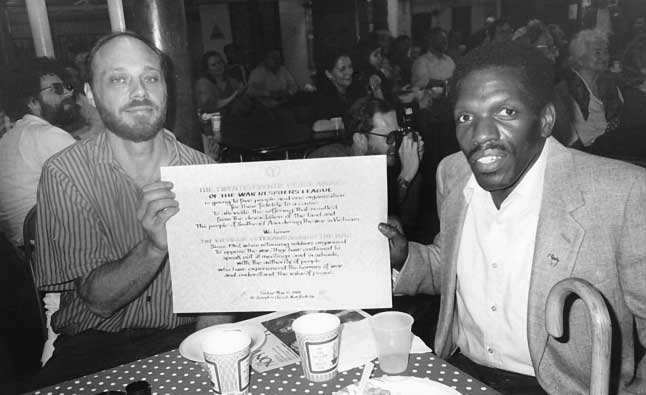
Anyway, my trip was just enough time for an iconic photo op (as seen in the blog #2 of this series) with some Civil Rights movement heavies followed by a few hours of walking before my return to NYC. There were 60 walkers that first day.
ALBUQUERQUE
“Madame Hearts says ‘God won’t let them drop the bomb’” — reassuring sign spotted in Albuquerque
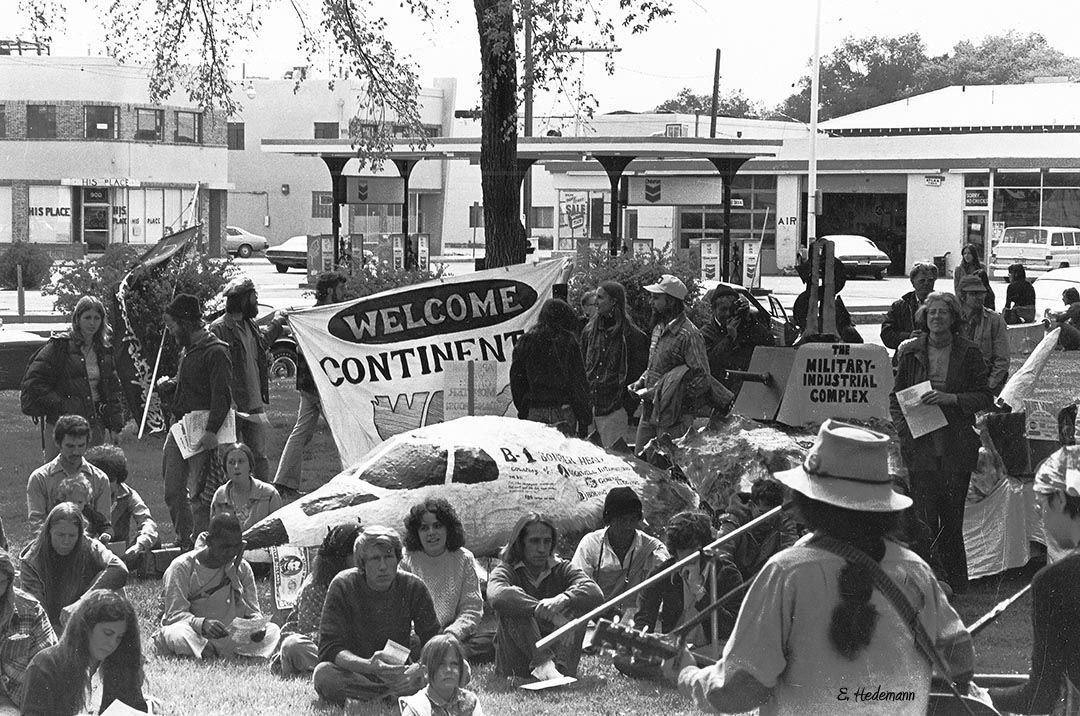
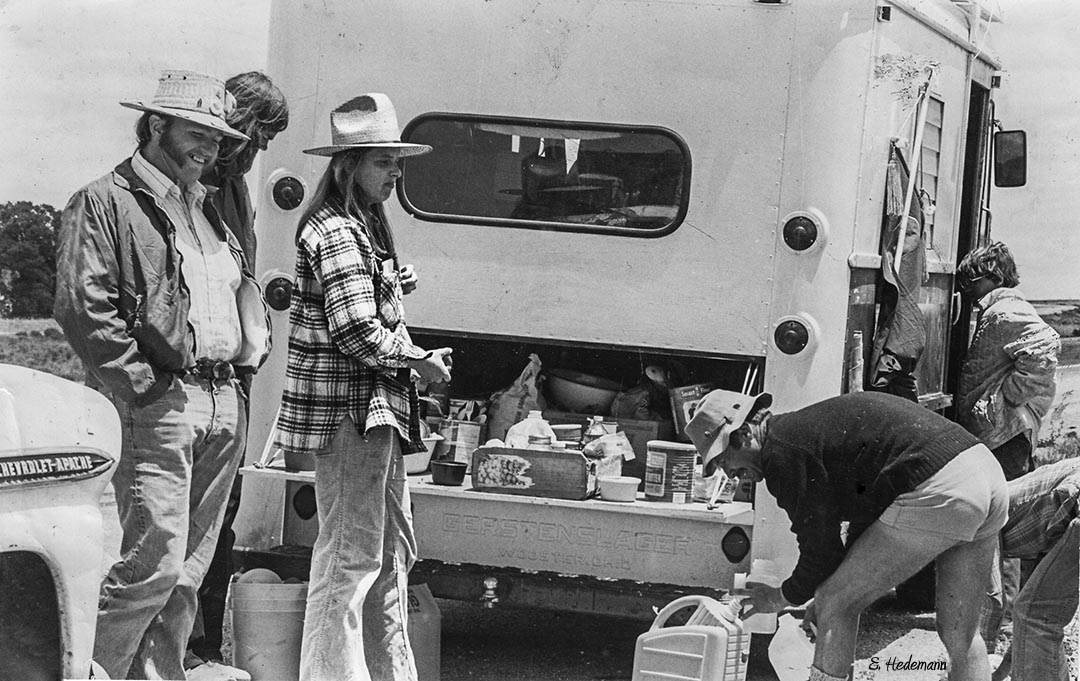
I’m inconspicuously dropped off at the back of the Walk (by longtime Albuquerque organizer Dorie Bunting, who died at 101 in 2023) as 14 walkers approach Albuquerque. Seldon Osborne, 65-year-old longshoreman and the first walker I greet, is bringing up the rear and determined to take every step of the 3,700-mile route from San Francisco to Washington, DC. From time to time, most walkers trade off walking for errands, such as breaking camp or going ahead to set up and prepare dinner in the more remote areas.
Once in Albuquerque we get more attention than we bargained for when four cop cars, lights a-flashing, surround a Walk support vehicle. “Just a routine check,” they say, since our vehicle has out-of-state (Arizona) plates. Hmm. A more appreciative welcome comes from a local TV news station as they film the Walk crossing the Rio Grande.
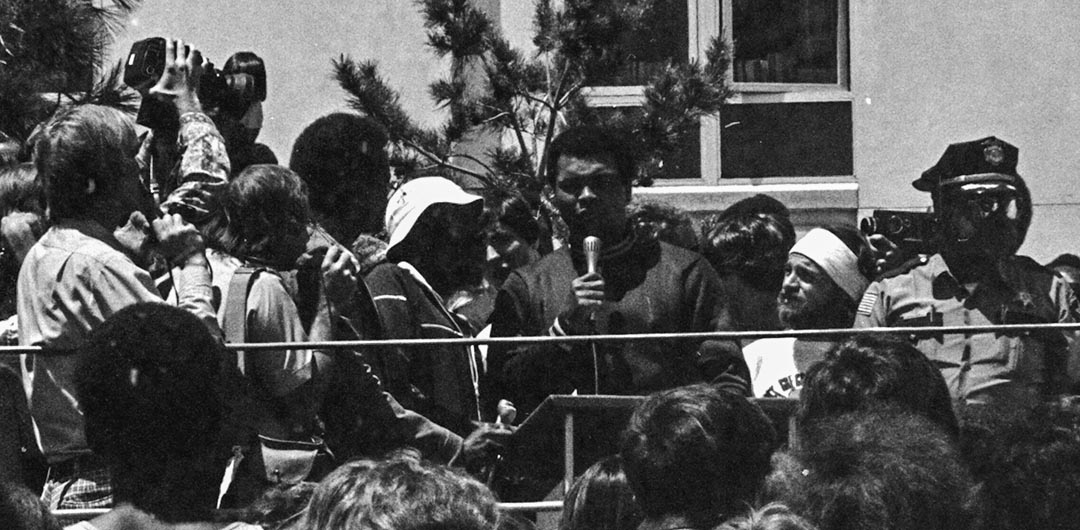
Over a five-day period, Albuquerque organizers put together a welcome dinner attended by three dozen, a downtown rally with 120 people, a pot luck for 80 people, a 5-mile march of 50 or 60 people from the University of NM to Kirtland AFB.
One of the unexpected, to me at least, surprises while in the city was the appearance of Muhammad Ali at a rally and press conference for Dick Gregory’s Bi-Centennial Continental Run Against Hunger. During the rally, long distance walkers Tom MacLean and Rev. Quijn Sato approach Gregory to sign the Hiroshima Appeal against nuclear weapons. He does.*
*Gregory, already a signer of the Walk call, had been in contact with Walk organizers in November 1975, spoke at the San Francisco start of the Walk, and would be speaking at the end in Washington.
LOS ALAMOS
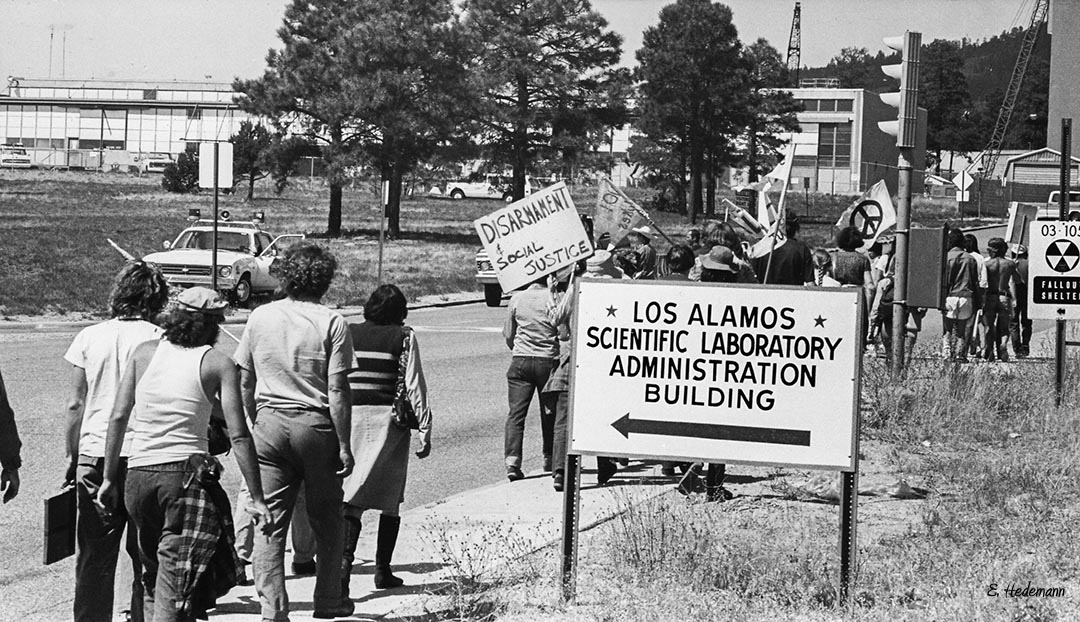
We made a side excursion to the 1945 birthplace of the bomb, Los Alamos (two-hour drive north of Albuquerque), where we meet up with the Colorado to New Mexico feeder and take a short walk to the entrance of Los Alamos National Laboratory for a demonstration.
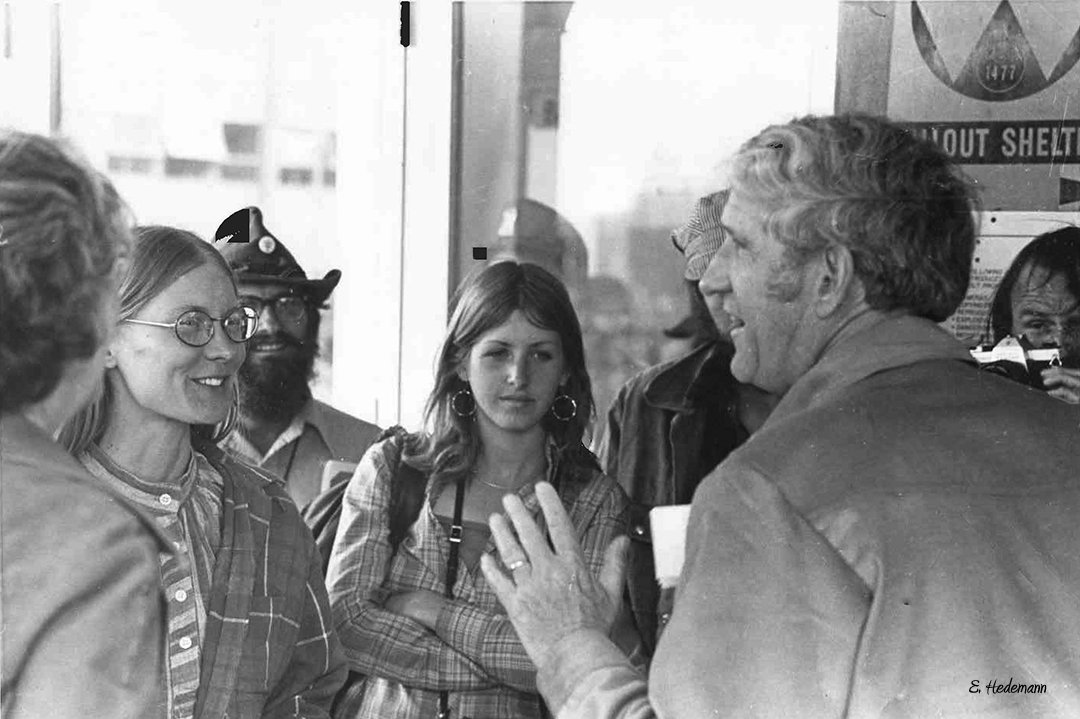
Harold Agnew, the Labs’ third director (eleven is currently running Los Alamos; note to sci-fi fans: not “Eleven” from “Stranger Things”), cheekily tries to sneak past us but was spotted by reporters. As we pondered a civil disobedience action, he returned for a brief debate. Three years later, during the growing escalation of antinuclear activity, he resigned, possibly not because of our demonstration and scintillating debating skills.
. . . AND BEYOND
After five days in Albuquerque, the Walk resumes its eastward trek into the desert and, once again, walkers are back to camping instead of being cared for by friendly and enthusiastic hosts. Four days later, I hitchhike back to Albuquerque for my flight to NYC and the demands of national organizing.
“It is now almost two weeks since the Walk set out from here…. After a few days of close association, they are gone and we don’t know what is happening with them except that they are trudging along across the Panhandle toward Oklahoma City….” — Dorie Bunting, May 1976
Fifth in a Series of 7 Blogs
Continental Walk Blog #1: Origins
Continental Walk Blog #2: Crisscrossing the Country
Continental Walk Blog #3: Convergence in Washington
Continental Walk Blog #4: The Organizing Begins
When the Walk reached Chicago three months later, Studs Terkel (a Walk endorser) conducted
a 50-minute radio interview on WFMT with long distance walkers Seldon Osborne and Susan Laflamme as well as with Walk supporters Sam Day (editor of Bulletin of Atomic Scientists) and Bernie Noven (Chicago educator).
Ed Hedemann was the national coordinator for The Walk (1975-1976) and WRL national staff member (1973 to 1986)
Share