The Farmworkers Strike and WRL’s 50th Anniversary
August 1973: “I was staying at Joan Baez’s Institute for the Study of Nonviolence in Palo Alto, Calif., having taken a Greyhound from Cleveland after graduating high school. There were some wooden racks in the garage for drop-ins like me. Robert Cooney was working on The Power of the People, a history of direct action up in the front house, and someone was helping Joan set up a huge Oakland Coliseum concert to support Amnesty International. One night Ira Sandperl came over to discuss his tactical roles in the civil rights movement and his lovely book, A Little Kinder.
“Suddenly two farmworkers striking against a hostile takeover of grape contracts by the mafia/GOP controlled Teamsters were killed in Kern County. An emergency call went out and three of us immediately reported to Delano and Bakersfield. Shortly before our arrival, Cesar Chavez and Dorothy Day and several others were arrested and jailed and fasted until their release about a week later.”
Memory shared by Seth Foldy, who also took the photo of Chavez and Day here. Seth was a correspondent for WIN Magazine and a member of WRL’s National Committee from about 1969 – 1975. On his return to Cleveland in 1973 he successfully organized removal of non-union grapes from his university campus. Seth also sponsored the creation of the digital WIN archives cited below, in honor of WRL’s 95th anniversary.

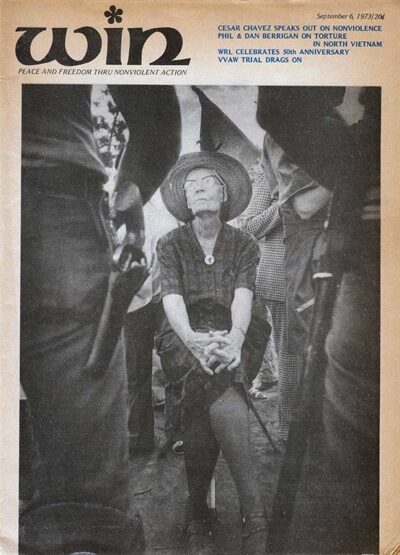
Not long after Day’s arrest the War Resisters League convened from August 5th to 7th in Asilomar, California, for what was certainly an historic 50th anniversary conference with more than 500 participants. Ira Sandperl and Joan Baez were among the presenters, and Dorothy Day was scheduled to speak also — but for that arrest mentioned above famously captured in a photograph by Bob Fitch. His photo was used the next month on the cover of WIN Magazine. That issue includes a detailed write-up of the conference.
It was at the end of the conference that more than 50 attendees, including Daniel Ellsberg, piled into cars and vans to caravan three hours east in answer to a call for support from the strikers. Strikers had been subject to brutality from police, teamsters, and growers and faced terrible conditions in the county jails. In a government effort to shut down the strike, a court order had been issued that limited picketers to one every 100 feet. New support was needed in the face of that outlandish order.
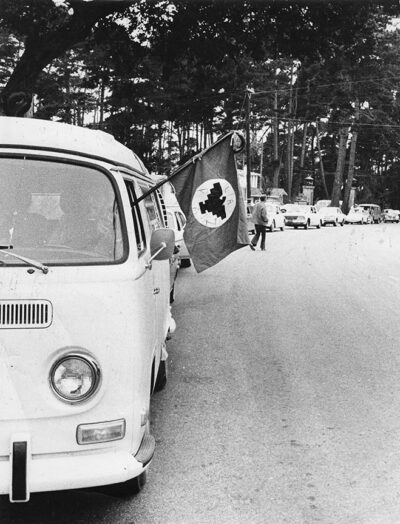
This paragraph from the UFW chronology gives a quick synopsis of the struggle:
Spring-summer 1973: When the UFW’s three-year grape contracts come up for renewal, growers — including the E&J Gallo winery — sign sweetheart pacts with the Teamsters without an election or any representation procedure. That sparks a bitter months-long strike by grape workers in California’s Coachella and San Joaquin valleys. Some 3,500 nonviolent strikers are arrested for violating anti-picketing injunctions, many of which are later overturned as unconstitutional, hundreds of strikers are beaten, dozens are shot, and two are murdered. In response to the violence, Chavez calls off the strike and begins a second grape boycott. Once again, strikers, union staff, and volunteers spread out to cities across North America, organizing popular support for the boycotts of table grapes, lettuce, and Gallo wine.
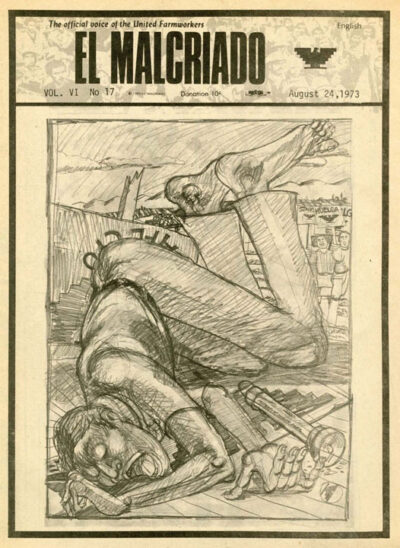
For a more immediate sense of what was happening in the fields, on the picket lines, and in talks between the UFW and the Teamsters, Seth shared a link to El Malcriado, “The official voice of the United Farmworkers.” The center spread on pages 8-9 includes photos and quotes from Dorothy Day, Joan Baez, Daniel Ellsberg, Bishop Metzger, and San Francisco’s Mayor George Moscone who was also out supporting the farmworkers. The article notes the support of 50 WRL members.
The 1970s UFW campaign for farmworkers to be able to organize, strike, and have a choice in their representation in negotiations with owners and growers involved hundreds of thousands of supporters across the country. The stories of struggle behind how food gets to our grocery stores and tables reached audiences of all ages. Today, that story may be told with renewed urgency as ICE and Border Patrol stalk farmworker communities and pluck workers from the fields. Some owners have found as many as 70% of their workers are afraid to go to work — a crushing choice for families who rely on that income to survive. While we can take inspiration from the successful organizing campaigns of the past, it’s no time to rest on our laurels. UFW is still fighting and so must we.
Ruth Benn was on the WRL staff from 1987-2000, is active with NYC WRL, and is on WRL’s History Committee. She is a long time war tax resister.
Share